
How to Build Secure Software for Nigerian Fintechs in 2026
A practical guide to application security, API protection, authentication, data security and building fintech products that can scale safely in Nigeria.
Klant Solutions
Software Development & Cybersecurity Practice

Technology architectures in Sub-Saharan Africa must treat infrastructure volatility, high-latency overseas routes, and rigorous local data sovereignty as design inputs rather than retrospective patches. Designing for local-first execution and cryptographic boundary protection ensures business continuity regardless of connectivity disruptions.
A practical guide to application security, API protection, authentication, data security and building fintech products that can scale safely.
Building a fintech product is not the same as building a normal web application.
You are not just storing names and emails.
You may be handling:
- Customer identities
- Bank and transaction information
- Payment details
- Financial records
- Personal data
- Authentication credentials
- API keys
- Business information
- Sensitive operational data
And that changes everything.
A security mistake in a fintech application can become a business problem very quickly.
So how do you build secure fintech software?
Do you need to spend millions on security tools?
Do you need a huge security team from day one?
Do you need to use every security product available?
Not necessarily.
What you need is a security-first approach to software development.
In this guide, we explain the key areas Nigerian fintechs should consider when building secure software in 2026.
Why Fintech Software Security Matters
Modern fintech applications are highly connected.
A typical application may communicate with:
- Payment processors
- Banks
- Identity verification providers
- SMS providers
- Email services
- Fraud detection systems
- Mobile applications
- Customer dashboards
- Internal administrative systems
- Third-party APIs
Every connection creates another point that needs to be secured.
This is why application security cannot be something you think about after the product has already been built.
It needs to be considered during architecture, development, testing and deployment.
The Central Bank of Nigeria’s risk-based cybersecurity framework for deposit money banks and payment service banks recognises the importance of protecting financial institutions’ information assets, managing cybersecurity risk and improving resilience.
For fintechs, that means security should be treated as part of the product architecture—not simply as an IT issue.
1. Start With the Business, Not the Security Tools
One of the biggest mistakes organisations make is starting with technology.
They ask:
“Which security product should we buy?”
That’s not the first question.
The first question should be:
“What are we trying to protect?”
Before designing a fintech application, you should understand:
- What the product does
- Who will use it
- What information it processes
- What financial transactions it handles
- Which third parties it connects to
- What regulations apply
- What level of availability is required
- What would happen if the system were compromised
- What the organisation can realistically invest in security
A small fintech with 5,000 users does not necessarily need the same architecture as a financial platform serving millions of customers.
Security should be risk-based and proportionate to the business.
2. Build Security Into the Software From Day One
Security should not be:
Build → launch → discover vulnerability → fix
A stronger approach is:
Plan → design → develop → test → deploy → monitor
This is often referred to as security by design.
Instead of asking:
“How do we secure this application?”
after development, developers and architects should ask:
“How could this feature be abused before we build it?”
For example, imagine a fintech application allows customers to transfer money.
A developer may think:
User enters amount → API processes transfer.
A security-focused team thinks further:
- Can a user modify the recipient ID?
- Can the same transaction be submitted repeatedly?
- What happens if the request is replayed?
- Can a user transfer more than their balance?
- Can an attacker manipulate the amount?
- Can a normal user call an administrative endpoint?
- What happens if the payment provider times out?
- Can an attacker automate thousands of requests?
- Is the transaction properly logged?
That difference in thinking is extremely important.
3. Secure Authentication
Authentication answers a simple question:
Who are you?
For fintech applications, authentication needs to be treated seriously.
Depending on the product, this can include:
- Strong passwords
- Multi-factor authentication
- Secure session management
- Short-lived access tokens
- Secure refresh-token handling
- Account lockout or throttling controls
- Device and login monitoring
- Secure password reset flows
- Protection against credential stuffing
- Risk-based authentication
But authentication is only half of the problem.
You also need authorization.
Authentication asks:
Who are you?
Authorization asks:
What are you allowed to do?
A user being authenticated does not mean they should be able to access every resource.
4. Get Authorization Right
This is one of the areas fintech applications cannot afford to get wrong.
Imagine an API like:
/api/accounts/12345
A user is logged in.
But are they actually allowed to access account 12345?
The application must verify that.
This is particularly important for APIs.
OWASP’s API Security Top 10 identifies Broken Object Level Authorization as a major API security risk. It occurs when applications fail to properly verify whether the requesting user is authorised to access a particular object or record.
The same principle applies to:
- Transactions
- Customer profiles
- Wallets
- Invoices
- Business accounts
- Payment records
- Admin functions
Never assume that because a user is logged in, they are authorised to access a resource.
Check authorization at the server.
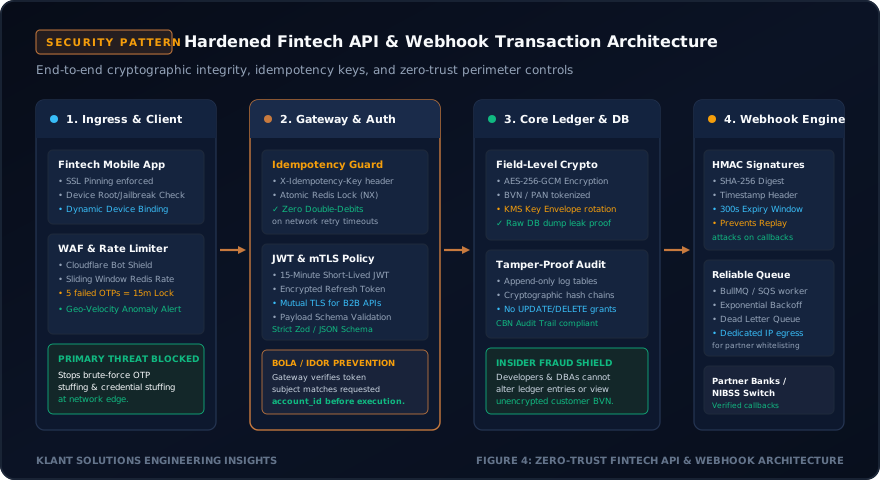
5. Protect Your APIs
APIs are the backbone of many modern fintech applications.
Your web application may communicate with your backend through APIs.
Your mobile application may use the same APIs.
Third-party partners may also consume APIs.
That makes APIs extremely important from a security perspective.
OWASP’s API Security Top 10 highlights risks including broken authentication, broken authorization, unrestricted resource consumption, security misconfiguration, improper API inventory management and unsafe consumption of third-party APIs.
A secure API strategy should consider:
Authentication
Who is making the request?
Authorization
What are they allowed to access?
Validation
Is the request data valid?
Rate limiting
How many requests should this client be allowed to make?
Logging
Can suspicious activity be identified?
Versioning
Which API versions are active?
Inventory
Do you actually know every API endpoint exposed by your organisation?
Third-party integrations
Can you trust the data and behaviour of the external service you’re consuming?
API security is not simply about putting an authentication header on every request.
It requires a broader security strategy.
6. Protect Sensitive Data
Fintech applications process valuable information.
That means you need to think carefully about:
What data are we collecting?
Why are we collecting it?
Where is it stored?
Who can access it?
How long do we keep it?
Who can we share it with?
Nigeria’s Data Protection Act establishes requirements around the processing and protection of personal data. The Nigeria Data Protection Commission identifies principles including lawful and transparent processing, purpose limitation, data minimisation, storage limitation, accuracy and appropriate security of personal data.
This means data protection should influence software architecture.
For example:
- Don’t collect data you don’t need.
- Don’t give every employee access to customer information.
- Don’t keep sensitive information indefinitely without a legitimate reason.
- Don’t expose personal information through API responses unnecessarily.
- Don’t put sensitive credentials inside source code.
- Don’t store secrets in Git repositories.
Security and privacy should influence the architecture from the beginning.
7. Secure Your Secrets
This sounds simple.
Yet it remains a common development mistake.
Never hard-code things like:
- Database passwords
- API keys
- Payment provider secrets
- JWT secrets
- Cloud credentials
- Encryption keys
inside your source code.
Instead, use appropriate secret-management mechanisms and environment-specific configuration.
And remember:
Removing a secret from your source code does not necessarily remove it from Git history.
If a sensitive credential has already been exposed, it may need to be revoked and rotated.
Security is not just about hiding secrets.
It’s also about managing their entire lifecycle.
8. Secure Third-Party Integrations
Fintechs rarely build everything themselves.
You may integrate with:
- Payment gateways
- Banks
- Identity verification providers
- SMS platforms
- Email providers
- Cloud services
- Fraud detection platforms
- Accounting platforms
- Open banking providers
Every integration introduces another dependency.
And dependencies create risk.
OWASP specifically highlights Unsafe Consumption of APIs as an API security risk because applications can make unsafe assumptions about data received from third-party services.
So don’t blindly trust an external API.
Validate its responses.
Handle failures.
Set appropriate timeouts.
Use secure credentials.
Monitor unusual behaviour.
And understand what happens if the third-party service becomes unavailable.
9. Think About Business Logic Security
Not every security vulnerability is a technical bug.
Some are business logic problems.
Consider a promotion:
“Get ₦5,000 when you complete your first transaction.”
What stops someone from creating multiple accounts?
Or:
“Withdraw up to ₦500,000 per day.”
Can the limit be bypassed by manipulating requests?
Or:
“Transfer money to another user.”
Can the same transaction be submitted multiple times?
These are not simply authentication problems.
They require developers and security professionals to understand how the business actually works.
Your security team should therefore understand the product.
Not just the infrastructure.
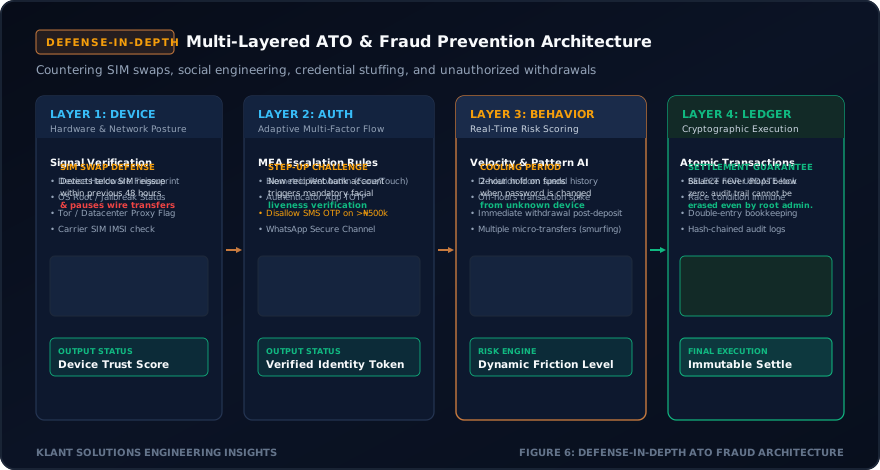
10. Protect Against Automated Abuse
A fintech application can be technically secure and still be abused.
Attackers may automate:
- Login attempts
- Account creation
- OTP requests
- Password resets
- Transaction attempts
- Promotional claims
- API calls
- Card verification
- Resource-intensive operations
This is why controls such as rate limiting, throttling, fraud detection and behavioural monitoring can be important.
OWASP’s API Security Top 10 specifically includes Unrestricted Resource Consumption, which can lead to service disruption and even unexpected operational costs when APIs and associated resources are abused.
The goal isn’t simply:
“Block hackers.”
It is also:
“Prevent legitimate functionality from becoming an easy automation target.”
11. Don’t Forget the Database
Your application code may be secure.
Your API may be secure.
But what about your database?
Database security should include appropriate:
- Access controls
- Network restrictions
- Encryption
- Backups
- Monitoring
- Credential management
- Patch management
- Disaster recovery procedures
Developers should also avoid unnecessary exposure of database information through APIs.
For example, an endpoint should return the data the client actually needs—not an entire database record simply because it is convenient.
Minimise what leaves the database.
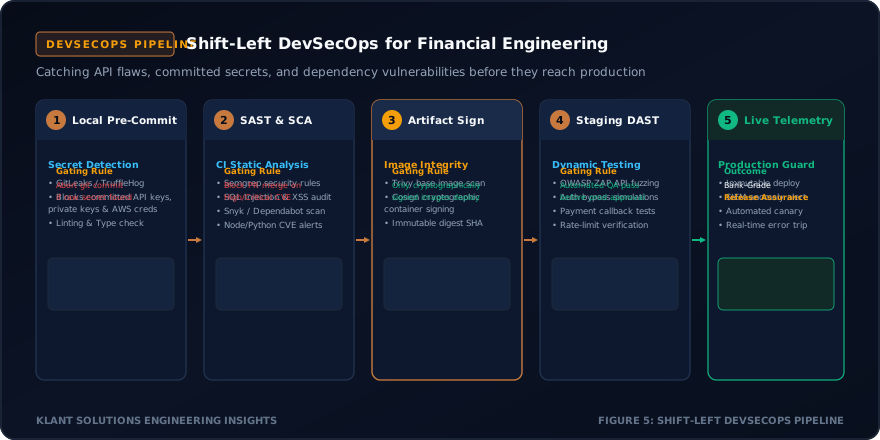
12. Build Security Into Your DevOps Pipeline
Security should continue after development.
A mature development pipeline can include security checks such as:
- Dependency scanning
- Static analysis
- Secret scanning
- Container scanning
- Infrastructure checks
- API testing
- Automated tests
- Vulnerability management
This is where DevSecOps becomes useful.
Instead of security being a separate department that checks the application once before launch, security becomes part of the development lifecycle.
The goal is simple:
Find problems earlier.
Fixing a vulnerability during development is generally easier than discovering it after customers are already using the product.
13. Monitor What Happens in Production
You cannot secure what you cannot see.
After deployment, organisations should monitor important security events.
For example:
- Failed login attempts
- Unusual account activity
- Privilege changes
- Suspicious API requests
- Large transaction patterns
- Repeated OTP requests
- Unexpected administrative actions
- Infrastructure anomalies
Logs should also be protected.
A security log containing sensitive information can create another security problem.
So monitoring needs to be designed carefully.
You need enough information to investigate incidents without unnecessarily exposing personal or sensitive data.
14. Have an Incident Response Plan
Eventually, something may go wrong.
The question is:
Will your team know what to do?
A fintech should have a defined process for:
- Detecting the incident
- Confirming the incident
- Containing the problem
- Investigating the cause
- Removing the threat
- Recovering affected systems
- Assessing impact
- Communicating with relevant stakeholders
- Learning from the incident
Don’t wait until an incident happens to decide who is responsible.
Security incidents are stressful enough without trying to create a response process at the same time.
15. Security Doesn’t Mean Buying Every Security Product
This is important.
A fintech doesn’t become secure because it purchased more tools.
You can have:
- Firewalls
- Endpoint protection
- SIEM
- WAF
- API security
- IAM
- Vulnerability scanners
- Cloud security tools
and still have insecure software.
Why?
Because technology doesn’t replace architecture, processes and engineering discipline.
The right technology depends on:
- Company size
- Number of users
- Transaction volume
- Infrastructure
- Risk profile
- Regulatory requirements
- Existing technology
- Security maturity
- Available budget
A startup may need a very different security architecture from a large financial institution.
The objective should be:
Use the right controls for the actual risk.
Not:
Buy the most expensive security stack available.
A Practical Secure Software Roadmap for a Nigerian Fintech
So where should a fintech start?
Here’s a practical approach.
Phase 1 — Understand
Document:
- Users
- Applications
- APIs
- Data
- Transactions
- Integrations
- Infrastructure
- Critical business processes
Phase 2 — Assess
Identify:
- Security weaknesses
- Excessive permissions
- API vulnerabilities
- Infrastructure risks
- Data exposure
- Third-party risks
- Authentication weaknesses
- Monitoring gaps
Phase 3 — Design
Build a security architecture covering:
- Identity
- Authentication
- Authorization
- APIs
- Applications
- Databases
- Cloud infrastructure
- Networks
- Endpoints
- Monitoring
Phase 4 — Build
Implement security controls alongside the product.
Not months later.
Phase 5 — Test
Conduct appropriate:
- Security testing
- API testing
- Vulnerability assessments
- Code reviews
- Configuration reviews
- Penetration testing where appropriate
Phase 6 — Deploy
Deploy with:
- Secure configurations
- Monitoring
- Backups
- Access controls
- Incident response procedures
Phase 7 — Improve
Security is continuous.
New features create new risks.
New integrations create new attack surfaces.
New regulations create new requirements.
And attackers continue to change their techniques.
So your security strategy needs to evolve with the product.
How Klant Solutions Approaches Secure Software Development
At Klant Solutions, we don’t believe security should be added to a product as an afterthought.
It should influence the way the system is designed.
Our approach starts with understanding the organisation.
Then we assess the:
- Business requirements
- Users
- Applications
- APIs
- Data
- Infrastructure
- Integrations
- Security risks
- Operational requirements
- Compliance considerations
From there, we can design and build the appropriate architecture.
Depending on the organisation and requirements, this may involve technologies and security platforms from partners such as Microsoft, Palo Alto Networks, F5 and Fortinet, alongside secure software engineering and cloud/DevOps practices.
The important point is this:
We don’t start with a product.
We start with the problem.
Because the right security architecture for a fintech with thousands of users may be completely different from the right architecture for a large financial institution.
The Goal Is Not Just Secure Software
The goal is secure, reliable and scalable software.
Your fintech should be able to:
- Protect customer information
- Secure transactions
- Control access
- Protect APIs
- Detect suspicious activity
- Recover from incidents
- Scale as usage grows
- Adapt as the business changes
And it should do all of this without creating unnecessary complexity.
Because security that nobody can operate properly is not a sustainable security strategy.
Final Thoughts
Fintech security is not one product.
It is not one firewall.
It is not one penetration test.
And it is certainly not something you should think about after launching.
It is a combination of:
Secure architecture.
Secure development.
Strong identity and access controls.
Protected APIs.
Responsible data handling.
Secure infrastructure.
Monitoring.
Testing.
Incident response.
And continuous improvement.
For Nigerian fintechs, the challenge is even more important because financial platforms operate within a highly connected environment involving customers, financial institutions, payment providers, regulators and technology partners.
Build security into the product from the beginning.
Not after the first incident.
Build securely. Scale confidently. Protect what matters.
Need Help Securing Your Fintech Application?
Whether you’re building a new fintech product, modernising an existing platform or reviewing the security of your current infrastructure, the first step is understanding where your actual risks are.
Klant Solutions helps organisations with:
- Secure software development
- Application security
- API security
- Cloud security
- Cybersecurity assessments
- Identity and access management
- Infrastructure security
- DevOps and secure deployment
- IT consulting
- Security architecture
Let’s build technology that is secure, reliable and ready to scale.
Klant Solutions — Driving indigenous technology innovation in Africa.