
Zero Trust Security in Africa: A Practical Guide for Banks, Fintechs and Enterprises
A comprehensive guide to implementing Zero Trust security architecture for African organizations. Learn how banks, fintechs, and enterprises can strengthen identity, access management, and cybersecurity defenses.
Klant Solutions
Cybersecurity & Infrastructure Security Practice

Technology architectures in Sub-Saharan Africa must treat infrastructure volatility, high-latency overseas routes, and rigorous local data sovereignty as design inputs rather than retrospective patches. Designing for local-first execution and cryptographic boundary protection ensures business continuity regardless of connectivity disruptions.
Do you know who is accessing your company’s systems right now?
Do you know which devices they are using?
Do you know what applications they can access?
Do you know what happens if one employee’s account is compromised?
And perhaps the most important question…
Does your organisation still trust someone simply because they are inside the network?
If the answer is yes…
You may have a security problem.
For years, organisations built security around a simple idea:
Keep the bad people outside.
Put a firewall around the network.
Protect the perimeter.
Allow employees inside.
And trust users who are already inside.
But businesses have changed.
Employees work remotely.
Applications run in the cloud.
Customers access systems through APIs.
Third-party vendors connect to internal platforms.
Employees use laptops, phones and other devices from different locations.
And attackers don’t always need to break through the front door.
Sometimes…
They simply use a legitimate account.
That is where Zero Trust Security comes in.
And no…
Zero Trust does not mean trusting nobody.
It means something more practical:
Never automatically trust access. Continuously verify it.
Let’s break it down.
What Is Zero Trust Security?
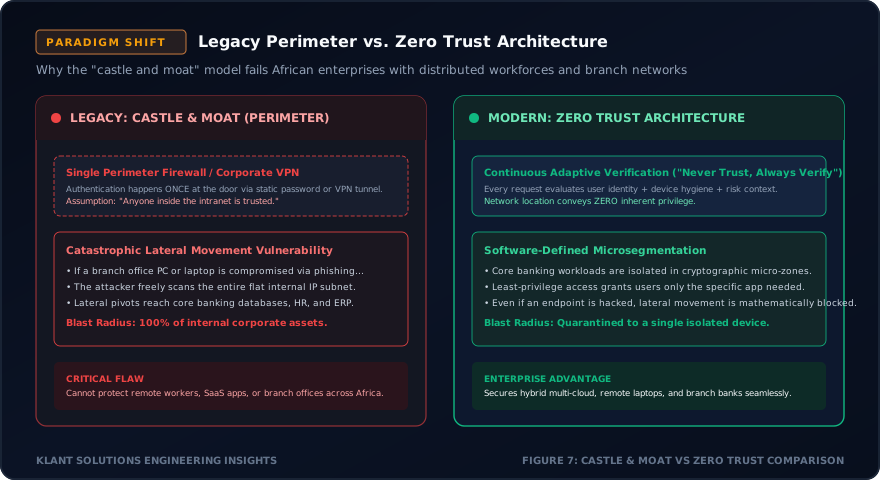
Zero Trust is a security approach based on the principle that users, devices, applications and network connections should not automatically receive trust simply because they are inside an organisation’s network.
Instead, access should be:
Verified.
Limited.
Monitored.
Continuously evaluated.
The National Institute of Standards and Technology (NIST) describes Zero Trust Architecture as an approach that moves security away from static, network-based perimeters toward protecting individual resources.
In simple terms:
Being inside the network does not automatically make you trusted.
Being an employee does not automatically give you access to everything.
Having a username and password does not automatically prove that the request is legitimate.
Every access request should be evaluated according to the organisation’s security policies.
Why Does Zero Trust Matter More in 2026?
Let’s look at how businesses operate today.
Your employees may work from:
- The office
- Home
- A hotel
- Another country
- A customer’s office
- A mobile device
Your applications may run across:
- Data centres
- Public clouds
- Private clouds
- SaaS platforms
- Third-party services
Your customers may access your business through:
- Web applications
- Mobile applications
- APIs
- Payment platforms
And your organisation may depend on:
- Contractors
- Vendors
- Technology partners
- Managed service providers
So…
Where exactly is your security perimeter?
There may not be one anymore.
That’s one reason modern security frameworks increasingly focus on identity, devices, applications and individual resources rather than assuming that everything inside a corporate network is trustworthy.
The Problem With “Inside the Network = Trusted”
Imagine an employee’s laptop gets stolen.
An attacker obtains the employee’s credentials.
The attacker connects to the corporate network.
The traditional security model may see:
“This user is inside.”
But the organisation should be asking:
Who is this user?
Is the device trusted?
Is the login normal?
Is the location unusual?
What application are they trying to access?
Does this employee normally perform this action?
Does this request match the user’s normal behaviour?
That is the mindset behind Zero Trust.
Zero Trust Is Not a Single Product
This is important.
You cannot simply buy:
“Zero Trust Software.”
And suddenly become a Zero Trust organisation.
Zero Trust is an architecture and security strategy.
It can involve technologies such as:
- Identity and Access Management
- Multi-Factor Authentication
- Privileged Access Management
- Endpoint security
- Network segmentation
- Secure access solutions
- Application security
- API security
- Encryption
- Security monitoring
- SIEM
- Vulnerability management
- Data protection
Different organisations will require different combinations.
The architecture comes first.
The products come second.
The Three Core Questions Behind Zero Trust
A simple way to understand Zero Trust is to think about three questions:
1. Who are you?
Identity.
2. What are you using?
Device and application context.
3. What are you allowed to access?
Authorisation.
And then…
Should you still be allowed to access it right now?
That last question is critical.
Access should not necessarily be permanent.

Identity Is the New Security Perimeter
Think about your organisation.
Your employees have accounts.
Your customers have accounts.
Your administrators have privileged accounts.
Your applications have service accounts.
Your APIs have credentials.
Your systems communicate with each other.
That means identity has become one of the most important security controls in modern organisations.
If an attacker compromises an important identity…
They may not need to hack your infrastructure directly.
They may simply log in.
That is why organisations should consider strong identity controls such as:
- Multi-factor authentication
- Strong password policies
- Single sign-on
- Role-based access control
- Privileged access management
- Conditional access
- Session controls
- Identity monitoring
Multi-Factor Authentication Is Not Optional for Critical Systems
Let’s make this simple.
A password is one thing you know.
But what happens if someone steals it?
They can use it.
Multi-factor authentication introduces another verification factor.
For example:
Something you know
A password.
Something you have
A security key or trusted device.
Something you are
Biometric authentication.
The goal is to make stolen credentials less useful to attackers.
For administrators, financial systems and other high-risk environments…
MFA should be treated as a foundational security control.
Least Privilege: Give People Only What They Need
Here’s a simple question.
Should an employee who manages customer support have access to your production database?
Probably not.
Should a developer automatically have access to every production credential?
Not necessarily.
Should an intern have administrator privileges?
Usually not.
This is the principle of least privilege.
Give users only the access they need to perform their role.
Nothing more.
This reduces the potential damage if an account is compromised.
What Is Privileged Access Management?
Some accounts are more dangerous than others.
Consider:
Domain administrators.
Cloud administrators.
Database administrators.
Security administrators.
Infrastructure engineers.
These accounts can make changes that affect an entire organisation.
If one of them is compromised…
the consequences can be serious.
Privileged Access Management, or PAM, focuses on controlling, monitoring and protecting these high-risk accounts.
A mature Zero Trust programme should pay particular attention to privileged identities.
Zero Trust and Nigerian Banks
Now let’s make this specific to Africa.
Banks operate highly sensitive environments.
They process:
- Financial transactions
- Customer information
- Authentication credentials
- Payment information
- Internal financial data
An attacker gaining access to a privileged account could potentially cause significant damage.
So banks need security controls that go beyond:
“The employee is on the bank’s network.”
They need stronger controls around:
Who is accessing what?
From which device?
From where?
At what time?
For what purpose?
With what level of privilege?
And:
What happens if the behaviour suddenly changes?
Zero Trust provides a framework for thinking about these questions.
Zero Trust and Fintech Companies
Fintechs have another challenge.
They often move quickly.
New applications are deployed.
APIs are created.
Third-party integrations are added.
Cloud services are introduced.
Mobile applications connect to backend systems.
And the business grows.
Fast.
That speed is valuable.
But it can also create security gaps.
A fintech should therefore consider Zero Trust principles across:
- APIs
- Cloud infrastructure
- Application environments
- Developer access
- Production systems
- Customer identities
- Internal applications
- Third-party integrations
Security should grow with the architecture.
It shouldn’t be added after the architecture has already become difficult to secure.
What About Telecoms and Large Enterprises?
The bigger an organisation becomes…
the more complicated access becomes.
You may have:
- Thousands of employees
- Multiple offices
- Contractors
- Vendors
- Remote workers
- Multiple applications
- Multiple data centres
- Cloud environments
- Legacy systems
And all these systems need to communicate.
Zero Trust can help organisations move from:
“Everyone inside can access the network.”
towards:
“Every user and application gets only the access it actually needs.”
That is a significant change.
Zero Trust for Remote Employees
Remote work has changed the security equation.
Your employee may be accessing company systems from:
Lagos.
Abuja.
London.
A hotel.
A home network.
A mobile connection.
The organisation cannot assume that every network the employee connects through is trustworthy.
Instead, security controls can evaluate:
- Identity
- Device health
- Location
- Application
- Authentication strength
- Access request
- Risk signals
This makes security less dependent on the physical location of the employee.
Device Security Matters Too
Imagine an employee has a legitimate account.
But their laptop:
- Has outdated software
- Has malware
- Is missing security patches
- Has a disabled firewall
- Has suspicious applications installed
Should that device automatically receive access to sensitive systems?
No.
Identity alone isn’t enough.
Zero Trust therefore considers the security state of the device as part of access decisions.
This is where endpoint detection and response, mobile device management and device compliance controls can become important.
Network Segmentation: Don’t Let One Breach Become Everything
Imagine your company has:
HR systems
Finance systems
Customer databases
Development environments
Production systems
Security infrastructure
Should they all sit in one unrestricted network?
No.
Segmentation limits how systems communicate.
If an attacker compromises one environment…
they should not automatically be able to move everywhere else.
This is one of the practical principles behind Zero Trust architecture.
Zero Trust and APIs
Modern businesses depend heavily on APIs.
Your frontend communicates with your backend.
Your mobile application communicates with APIs.
Your payment platform communicates with another service.
Your CRM communicates with your internal applications.
Your partners may consume your APIs.
That creates another question:
How do you know that every request is legitimate?
API security can involve:
- Strong authentication
- Authorisation
- Rate limiting
- Input validation
- Encryption
- API gateways
- Monitoring
- Logging
- Threat detection
Zero Trust principles can therefore extend beyond human users.
Applications and services need identities too.
What About Cloud Security?
Moving to the cloud does not remove the need for Zero Trust.
In fact…
Cloud environments can make identity even more important.
Your infrastructure may contain:
- Cloud administrators
- Developers
- Service accounts
- Containers
- Databases
- APIs
- Storage buckets
- Serverless functions
Each may require different permissions.
One misconfigured identity or permission can expose resources that should never have been accessible.
That is why cloud security and Zero Trust increasingly overlap.
Zero Trust and Cybersecurity Products
Organisations may use technology from vendors such as:
- Palo Alto Networks
- Fortinet
- Microsoft
- F5
- Cisco
- Cloud providers
- Specialist identity and security platforms
But don’t make this mistake:
Buying a security product does not create a security strategy.
You need to understand:
What are we protecting?
Who needs access?
What are the risks?
What controls already exist?
Where are the gaps?
What should happen if something goes wrong?
Then select the appropriate technology.
How Much Does Zero Trust Cost?
This is another question without one universal answer.
A small company may begin with:
- MFA
- Strong identity management
- Role-based access
- Endpoint security
- Basic monitoring
- Secure application architecture
A large enterprise may require:
- Enterprise identity infrastructure
- PAM
- Network segmentation
- Advanced endpoint protection
- SIEM
- Security analytics
- Secure access solutions
- Application security
- Dedicated security operations
The cost depends heavily on:
Users.
Applications.
Infrastructure.
Data sensitivity.
Regulatory requirements.
Existing security maturity.
Risk profile.
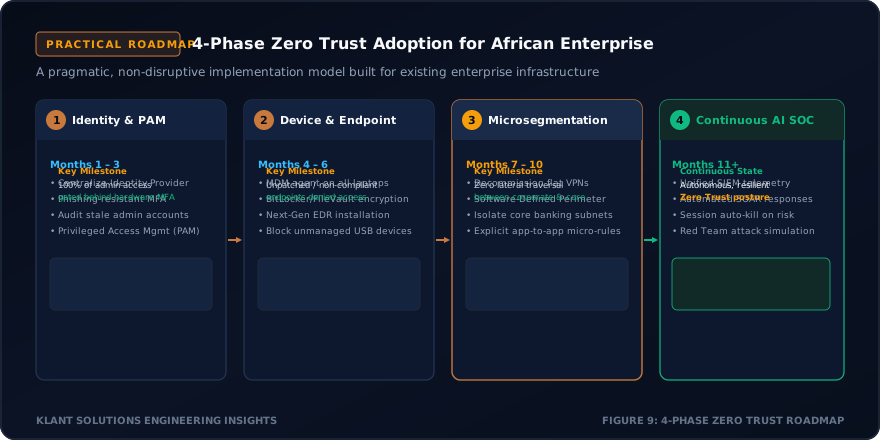
That means Zero Trust should be implemented progressively.
You Don’t Need to Implement Everything at Once
This is where many organisations become overwhelmed.
They read about Zero Trust and think:
“We need to replace our entire security infrastructure.”
Not necessarily.
Start with the highest-risk areas.
For example:
Phase 1
Secure identities.
Implement MFA.
Review privileged accounts.
Remove unnecessary access.
Phase 2
Secure devices.
Improve endpoint protection.
Enforce security policies.
Monitor device health.
Phase 3
Segment critical environments.
Separate production from development.
Protect sensitive databases.
Restrict unnecessary network communication.
Phase 4
Secure applications and APIs.
Strengthen authentication.
Improve authorisation.
Monitor API activity.
Protect application secrets.
Phase 5
Improve monitoring.
Centralise important security logs.
Create alerts.
Develop incident-response procedures.
Phase 6
Continuously improve.
Review permissions.
Review identities.
Review devices.
Review applications.
Review security events.
Review policies.
Zero Trust is not a one-day installation.
It is a continuous security programme.
A Practical Zero Trust Roadmap for African Organisations
Before implementing Zero Trust, start by understanding your current environment.
Step 1: Identify Your Critical Assets
What would hurt the business most if compromised?
Identify:
- Customer databases
- Financial systems
- Production applications
- Cloud infrastructure
- Administrative systems
- Intellectual property
- Sensitive documents
Protect those first.
Step 2: Map Your Users and Identities
Who has access?
Employees?
Contractors?
Partners?
Applications?
Service accounts?
Administrators?
Document them.
You may discover accounts that shouldn’t exist anymore.
Step 3: Review Existing Permissions
Ask:
Does this person actually need this access?
If not…
Remove it.
This simple exercise can significantly reduce unnecessary exposure.
Step 4: Strengthen Authentication
Implement:
- MFA
- Strong authentication
- Conditional access
- Secure password policies
- Privileged identity controls
Step 5: Secure Devices
Know which devices connect to your environment.
Know whether they are secure.
Know whether they are patched.
Know whether they meet your security requirements.
Step 6: Segment Your Infrastructure
Separate critical environments.
Restrict unnecessary communication.
Don’t allow one compromised system to become a gateway into everything else.
Step 7: Secure Applications and APIs
Protect:
- Authentication
- Authorisation
- APIs
- Secrets
- Sessions
- Sensitive data
Security needs to exist inside the application itself.
Step 8: Monitor and Respond
You cannot protect what you don’t monitor.
Collect relevant logs.
Detect suspicious behaviour.
Create alerts.
Develop an incident-response process.
And test it.
The Biggest Zero Trust Mistakes to Avoid
Mistake 1: Treating Zero Trust as a Product
It isn’t.
Zero Trust is an architectural and security approach.
Mistake 2: Buying Security Tools Without an Assessment
More tools do not automatically mean more security.
You can have ten security products and still have a serious vulnerability.
Mistake 3: Ignoring Identity
Compromised credentials remain a major security problem.
Identity needs to be treated as a core security control.
Mistake 4: Giving Everyone Administrator Access
Convenient?
Maybe.
Secure?
No.
Mistake 5: Forgetting Service Accounts
Applications communicate with other applications.
Those identities need protection too.
Mistake 6: Ignoring Legacy Systems
Many African enterprises operate a mixture of modern cloud systems and older infrastructure.
Your Zero Trust strategy needs to account for both.
Mistake 7: Trying to Implement Everything at Once
Start with your highest-risk assets.
Then improve progressively.
What Does a Mature Zero Trust Environment Look Like?
It doesn’t mean:
“Nobody can access anything.”
It means:
The right person gets the right access to the right resource under the right conditions.
And that access is continuously evaluated.
A mature environment should be able to answer questions such as:
Who accessed this system?
When did they access it?
From which device?
What did they access?
What permissions did they have?
Was the behaviour normal?
What happens if the account becomes compromised?
If your organisation cannot answer these questions…
there is probably room to improve your security architecture.
Zero Trust Is About Reducing the Blast Radius
Let’s say something goes wrong.
Because eventually…
something will.
An employee account could be compromised.
A laptop could be infected.
A vulnerability could be exploited.
A third-party account could be abused.
The objective of Zero Trust is not to magically make attacks impossible.
That’s not realistic.
The objective is to make it much harder for an attacker to move freely through your environment.
If one account is compromised…
limit what it can reach.
If one device is compromised…
limit what it can access.
If one application is compromised…
limit its ability to move deeper into the environment.
That is the idea of reducing the blast radius.
Security Should Be Designed Around Your Business
A bank.
A fintech.
A telecom company.
A university.
A consulting firm.
A government organisation.
A technology startup.
They do not have the same security requirements.
So they should not have the same security architecture.
The right Zero Trust strategy should consider:
Your users.
Your applications.
Your data.
Your infrastructure.
Your budget.
Your regulations.
Your risk.
And your organisation’s ability to operate the security controls after implementation.
Where Does Klant Solutions Fit?
Cybersecurity should not begin with:
“Which security product should we buy?”
It should begin with:
“What are we trying to protect?”
At Klant Solutions, our approach is built around understanding the organisation first.
We can help organisations assess:
- Identity and access
- Network architecture
- Cloud infrastructure
- Applications
- APIs
- Endpoint security
- Security monitoring
- Existing security controls
- Technology risks
From there, the appropriate security architecture and technology can be considered.
That may involve technologies from established enterprise security providers such as Palo Alto Networks, Fortinet, F5, Microsoft and other platforms where appropriate.
The technology should support the security strategy.
Not become the strategy.
Start Small. Secure What Matters Most.
You do not need to transform your entire organisation overnight.
Start with the systems that matter most.
Secure your identities.
Protect privileged accounts.
Strengthen authentication.
Review permissions.
Secure your devices.
Segment critical systems.
Protect your applications and APIs.
Monitor what matters.
Then continue improving.
Because cybersecurity isn’t a project you complete once.
It is an ongoing responsibility.
Is Your Organisation Ready for Zero Trust?
Ask yourself:
Do employees have more access than they actually need?
Do administrators use permanent privileged accounts?
Is MFA enabled for critical systems?
Do you know which devices connect to your environment?
Are production and development environments properly separated?
Can you identify unusual login behaviour?
Are your APIs properly protected?
Can you quickly revoke a compromised account?
Do you know what would happen if an administrator’s credentials were stolen?
If some of those answers make you uncomfortable…
that’s useful information.
It means you know where to start.
The Future of Enterprise Security Is Not “Trust Nobody”
It is more practical than that.
It is:
Verify.
Limit.
Monitor.
Adapt.
Respond.
The modern African organisation cannot assume that everything inside its network is safe.
Employees are remote.
Applications are distributed.
Cloud infrastructure is expanding.
APIs connect businesses to the outside world.
Third parties have legitimate access.
And attackers continue to look for the weakest identity, device or application they can find.
Zero Trust provides a framework for dealing with that reality.
Not by making access impossible.
But by making access intentional, controlled and continuously evaluated.
Ready to Strengthen Your Organisation’s Security Architecture?
If your organisation is reviewing its cybersecurity posture, modernising its infrastructure or preparing for greater cloud adoption, the first step should not be buying another security product.
Start with understanding your risk.
Klant Solutions helps African businesses and institutions approach technology with security, practicality and the realities of their operating environment in mind.
Our cybersecurity and IT capabilities can support organisations across:
- Zero Trust architecture
- Identity and access management
- Network security
- Cloud security
- Application security
- API security
- Security monitoring
- Infrastructure security
- Cybersecurity assessment
- IT consulting
Don’t wait until an incident tells you where your security gaps are.
Understand them now.
Build securely. Verify continuously. Protect what matters.